You just got a job offer. The salary looks… okay. Not what you hoped for, but they want an answer by tomorrow. Your instinct is to say yes before they change their mind.
That instinct costs most people over $634,000 over their career. According to Harvard Law School research, a single successful salary negotiation — even a modest $5,000 increase — compounds into six figures over 40 years of work. And yet 55% of professionals never even try.
In 2026, AI has completely changed the preparation side of this. You no longer need a $300/hr career coach to prepare. You need the right prompts, the right scripts, and the right timing. Here’s exactly what works.
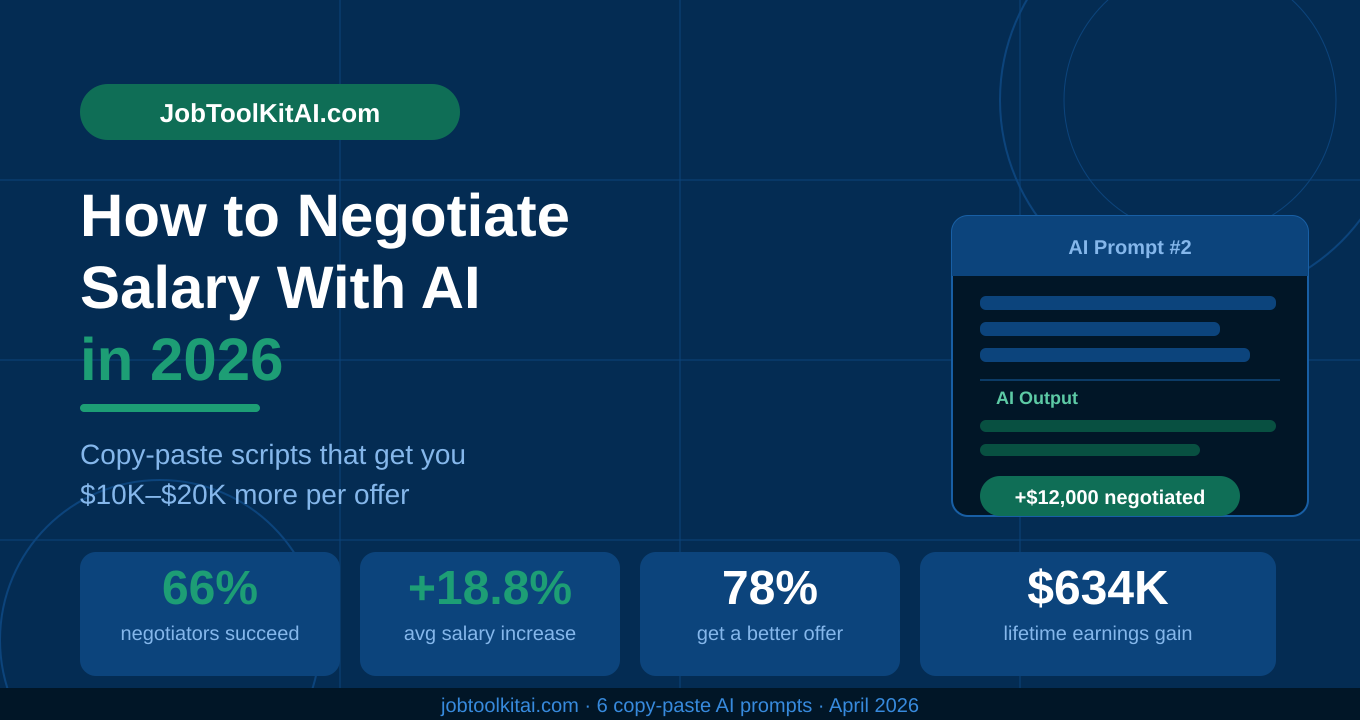
| 66% of negotiators succeed | +18.8% avg salary increase | 78% get a better offer | $634K lifetime earnings gain |
Source: Pew Research Center / Harvard Law School salary negotiation research
Why Most People Leave Money on the Table
The number one reason people don’t negotiate is fear. Fear the offer will be rescinded. Fear they’ll look greedy. Fear of saying the wrong thing.
The data tells a different story: 78% of employers who receive a counteroffer respond with a better package. Hiring managers build negotiation room into initial offers — it’s expected. An offer is rarely pulled because a candidate negotiated professionally.
The second reason is preparation. Most people don’t know their market rate, don’t have a script, and haven’t practiced the conversation. AI solves all three.
Step 1: Research Your Market Rate With AI
Before you say a single word about numbers, you need data. Gut feelings don’t negotiate — market benchmarks do. Use this prompt to anchor your research:
| 🤖 Prompt #1 — Market Rate Research |
| You are a compensation analyst. Give me the salary range for a [JOB TITLE] with [X] years of experience at a [COMPANY SIZE / INDUSTRY] company in [CITY, STATE]. Include: base salary low/mid/high, typical bonus range, equity if applicable, and total comp. Sources: Levels.fyi, Glassdoor, BLS. Present as a table. |
| 📊 Sample AI Output |
| Role: Senior Product Manager | Location: Austin, TX | Experience: 6 years Base: $118K – $142K – $168K | Bonus: 10–20% | Equity: $15K–$40K RSU Total Comp Target: $145K–$195K | Source: Glassdoor / Levels.fyi (Apr 2026) |
Once you have this data, you have your anchor number — the figure you’ll reference when you counter. Rule of thumb: target the mid-to-high end of your range, not the floor. You can always come down. You can’t go up from a lowball.
Want to go deeper? The salary negotiation scripts inside JobToolKitAI’s Career Pro toolkit include 15+ compensation-specific prompts pre-built for this exact research phase.
Step 2: Build Your Counteroffer Script With AI
Once you have your market data, you need the exact words to say. This is where most people freeze. Here’s the prompt that eliminates that:
| 🤖 Prompt #2 — Counteroffer Email Script |
| Write a counter-offer email for a [JOB TITLE] role. The offer is $[OFFER]. My target is $[TARGET]. Use market data showing the mid-range is $[MARKET MID]. Keep it under 150 words. Tone: grateful, confident, collaborative. End with a specific ask, not a question. |
| 💬 Sample AI Output |
| Hi [Name], I’m genuinely excited about this role and the team. After reviewing current market data for this position in [City] — where the mid-range sits around $[MARKET MID] — I’d like to respectfully counter at $[TARGET]. I’m confident I’ll deliver strong ROI quickly given [1 specific strength]. I’m happy to discuss further. Looking forward to making this work. |
Notice what this script does not say: “I was hoping for more” or “I need more to cover my expenses.” Those frames put the conversation in the wrong place. Market data is neutral, professional, and hard to argue with.
For a full look at what real negotiations look like — including the exact dollar amounts users have secured — see the before vs after results from JobToolKitAI users.
Step 3: Prepare AI-Powered Objection Responses
Every negotiation hits a wall. The employer pushes back. Your preparation determines what happens next. Here are the 4 most common objections and the AI prompts to handle each one:
| 🤖 Prompt #3 — Objection Handler |
| Write 4 professional responses to these salary objections. Tone: firm but collaborative. Each response under 60 words. 1. “This is the max for this level.” 2. “We can revisit in 6 months.” 3. “We have internal equity constraints.” 4. “The budget is fixed.” |
| 💬 Sample Output for Objection 1 |
| “I understand internal bands exist, and I respect that. Based on market data showing $[X] for this scope, I’d love to explore whether we can bridge the gap through a signing bonus or accelerated review at 90 days. Would either of those be possible?” |
The key principle across all four responses: never make it personal, always make it solvable. You’re not asking for a favour — you’re solving a business problem together.
Step 4: Negotiate Beyond Base Salary
Base salary is just one line item. When the base is genuinely fixed, a well-prepared candidate negotiates the total package. Most people leave significant value on the table by stopping at salary alone.
| 🤖 Prompt #4 — Total Compensation Negotiation |
| The base salary is fixed at $[AMOUNT]. What other compensation elements should I negotiate, ranked by dollar value? For each, give me a one-sentence script to ask for it professionally. Role: [JOB TITLE] at [COMPANY TYPE]. |
| 💬 Sample AI Output (top 5) |
| 1. Signing bonus — “Could we add a one-time signing bonus of $[X] to bridge the gap?” 2. Equity/RSUs — “Could we increase the equity component given the market rate differential?” 3. Remote flexibility — “I’d love to confirm full remote flexibility — is that something we can lock in writing?” 4. PTO — “Could we add 5 additional PTO days in lieu of a salary increase?” 5. Early review — “Could we schedule a 90-day review with a defined raise trigger?” |
| 💡 Pro Tip All 15+ salary negotiation scripts are pre-built inside the JobToolKitAI Executive toolkit — including scripts for FAANG offers, competing offer leverage, and remote/relocation negotiations. The Career Pro plan at $39 one-time includes the core salary scripts for most job seekers. |
Step 5: Practice the Conversation With AI
Reading scripts isn’t the same as saying them out loud under pressure. The single most effective preparation technique is AI roleplay — and it’s available free with any AI tool.
| 🤖 Prompt #5 — Salary Negotiation Roleplay |
| You are a hiring manager at [COMPANY]. You’ve just extended an offer of $[AMOUNT] for a [ROLE]. I’m going to negotiate. Play the role realistically — push back on my counter. After 3 rounds, give me feedback on: what I did well, what I should have said differently, and the 1 thing that would have moved you most. |
| 💬 Why This Works |
| Practice reveals the pauses, the filler words, the places where you instinctively back down. Most users run 3–5 rounds before the real conversation. Each round takes under 5 minutes. Compared to a $300/hr career coach — the ROI is immediate. |
This is exactly the kind of tool that’s baked into the JobToolKitAI Interview Simulation Coach — pre-configured for job offer scenarios, not just interview questions.
Timing: When to Bring Up Salary (And When Not To)
Even the best script fails at the wrong moment. Here’s the negotiation timeline that maximises your outcome:
- During the interview process: Do not bring up salary first. Let the employer anchor. If pressed, give a range based on your research, not a single number.
- When you receive a verbal offer: Say “Thank you — I’m very excited. Can I have 24 hours to review the full details?” This buys time without commitment.
- After receiving written offer: This is your moment. Use the scripts above. Never negotiate on the spot without preparation.
- After accepting: The negotiation window is closed. This is why preparation matters before the written offer arrives.
| ⚠️ Common Mistake Accepting a verbal offer before receiving it in writing is the most common negotiation mistake. A verbal “yes” locks you in. Always ask for the written offer first — even if you plan to accept. |
What to Say When They Say Yes
Once an employer matches your counter or offers a revised package, the conversation isn’t over — it just moved to the acceptance phase. How you close matters.
| 🤖 Prompt #6 — Offer Acceptance Email |
| Write a professional offer acceptance email for a [JOB TITLE] role at [COMPANY]. Salary agreed: $[FINAL AMOUNT]. Include: genuine enthusiasm, confirm start date, one sentence reinforcing my fit. Under 120 words. |
A strong acceptance email sets the tone for your first 90 days. It’s also a chance to confirm any verbal agreements in writing — remote flexibility, signing bonus, early review dates. If it isn’t in the acceptance email, it didn’t happen.
The Complete AI Salary Negotiation Checklist
- Research: Run Prompt #1 to establish your market range before any conversation
- Anchor: Target mid-to-high of the market range, not the floor
- Script: Use Prompt #2 to build your counteroffer email — under 150 words, data-driven, confident
- Objections: Prepare responses to all 4 common objections with Prompt #3
- Total comp: If base is fixed, use Prompt #4 to negotiate signing bonus, equity, PTO, remote, and review dates
- Practice: Run 3 rounds of AI roleplay with Prompt #5 before the real conversation
- Timing: Never negotiate on the spot — always ask for 24 hours after a verbal offer
- Close: Confirm all agreements in the written acceptance email
Frequently Asked Questions
Will negotiating salary make them rescind my offer?
Almost never. Research shows employers expect negotiation and factor room into initial offers. A professional, data-backed counter almost never results in an offer being withdrawn. The risk of not negotiating — leaving $10K–$20K on the table — is far higher than the risk of negotiating professionally.
How much should I ask for above the initial offer?
Typically 10–20% above the offer, anchored to market data. If the offer is already at the high end of market, a 5–10% counter is appropriate. Never counter without knowing your range first — run Prompt #1 above before any negotiation.
Can I use AI to negotiate a raise at my current job?
Yes — the same principles apply. Use Prompt #1 to research internal market rates, document your contributions with specific metrics, and use Prompt #3 to prepare for common objections. For a full strategy, the JobToolKitAI Career Pro plan includes a dedicated raise negotiation prompt sequence.
What if I’ve never negotiated before?
Start with the AI roleplay (Prompt #5). Run it 3–5 times before the real conversation. Most first-time negotiators report feeling significantly more confident after just 2–3 practice rounds. The toolkit also includes beginner-friendly scripts in the Fast Track plan ($19) if you’re just getting started.
How is this different from just using ChatGPT?
Generic ChatGPT prompts give generic outputs. The salary scripts inside JobToolKitAI are engineered specifically for ATS, recruiters, and negotiation dynamics — with context built in for different industries, seniority levels, and company types. See the full JobToolKitAI vs ChatGPT comparison for a side-by-side breakdown.
I got the job — what’s next?
Once you’ve accepted, focus on getting interviews for your next role, using all the tools you’ve built. Start with a strong resume foundation — our guide on how to use AI prompts to tailor your resume for any job covers the same copy-paste approach for job applications.
| Get the Full Salary Negotiation Script Library 125+ AI prompts including 15+ salary negotiation scripts — for every scenario, every seniority level. One-time $39, yours forever. → Get JobToolKitAI Career Pro — jobtoolkitai.com |
Related Articles:
- Best AI Resume Builder 2026: We Tested 6 Tools
- How to Use AI Prompts to Tailor Your Resume for Any Job in 2026
- 80% of Jobs Are Never Posted: How to Find Hidden Jobs
- ATS Score Below 50? Here’s Exactly How to Fix Your Resume
About the Author: Written by the JobToolKitAI team — career strategists, prompt engineers, and ATS researchers. Questions? support@jobtoolkitai.com