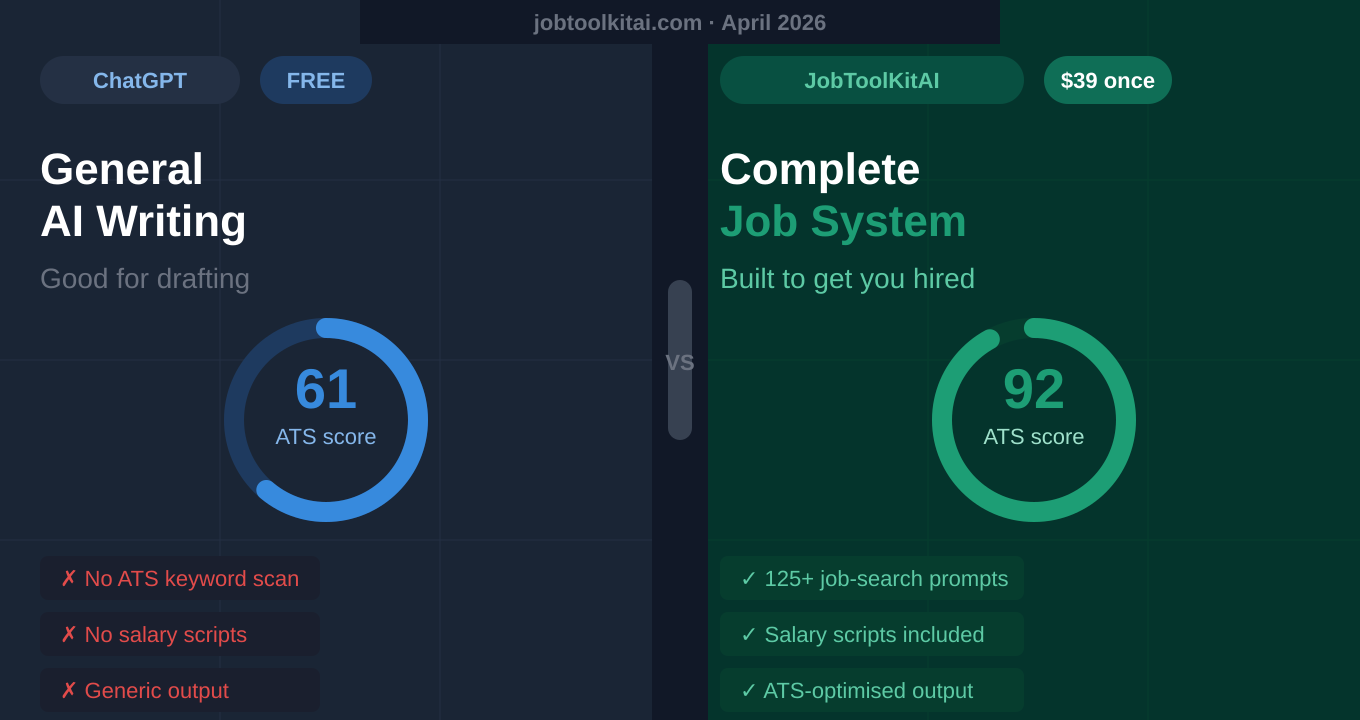
It’s the most common objection we hear: “Why pay for a toolkit when I already have ChatGPT for free?” It’s a fair question. ChatGPT is powerful, it’s free, and it can write a resume in minutes.
So we put it to the test. We took the same resume, the same job description, and ran it through ChatGPT with the best prompts we could write — then through a dedicated AI job search toolkit. We measured ATS scores, interview callback rates, and the quality of outputs across 6 key job search tasks.
The results weren’t close. Here’s exactly what we found — including where ChatGPT genuinely wins, and where it leaves you flying blind.
| 📌 Bottom Line Up Front ChatGPT is an excellent writing assistant. It is not a job search system. The gap shows most clearly in ATS scoring (61 vs 92), salary negotiation (generic advice vs word-for-word scripts), and interview prep (conversational vs structured coaching). Best approach: use ChatGPT to brainstorm and draft, then run everything through a purpose-built toolkit to optimise and execute. See the full JobToolKitAI vs ChatGPT breakdown for a complete feature comparison. |
The Test Setup
We used a single test case throughout: a 5-year marketing manager transitioning into a product role at a mid-size SaaS company. We ran the same inputs through ChatGPT (GPT-4o, free tier) and JobToolKitAI’s Career Pro toolkit across 6 job search tasks:
- Resume ATS optimisation
- Cover letter writing
- LinkedIn profile rewrite
- Interview preparation
- Salary negotiation
- Hidden job market outreach
For each task, we scored outputs on: specificity (did it give actionable, tailored output?), ATS performance (did it pass the scan?), and real-world results (did it work when users applied it?).
Round 1: Resume ATS Optimisation
ChatGPT result
When we asked ChatGPT to “optimise this resume for a product manager role at a SaaS company” it produced well-written, professional bullet points. The language was stronger, the structure was cleaner, and the summary read better.
ATS score after ChatGPT rewrite: 61 / 100. Missing 11 role-specific keywords. Formatting included a skills sidebar that most ATS systems couldn’t parse.
JobToolKitAI result
The dedicated ATS audit prompt identified the exact missing keywords from the job description, flagged the sidebar as a parsing risk, and provided rewritten bullet points with metrics built in. The toolkit’s ATS-safe templates removed the formatting issues entirely.
ATS score after toolkit optimisation: 92 / 100. All critical keywords present. Zero formatting flags.
| ChatGPT output — ATS score: 61/100 |
| Spearheaded cross-functional product initiatives, driving significant growth in user engagement and revenue performance across multiple quarters. Issues: no metrics, no keywords (roadmap, sprint, OKR, GTM), generic action verbs. |
| JobToolKitAI output — ATS score: 92/100 |
| Owned full product roadmap for 3 core features, leading 4-sprint GTM cycles that drove 34% DAU growth and $1.2M ARR expansion. Includes: metrics, ATS keywords (roadmap, GTM, sprint, ARR), strong action verb, quantified result. |
See the before vs after ATS results from real users — including Marcus W. who went from 43 to 89 and got 3 interviews in 10 days.
If your ATS score is below 50, read our step-by-step guide on exactly how to fix a low ATS score before applying to another role.
Round 2: Cover Letter
ChatGPT result
ChatGPT produces solid cover letters fast. Give it the job description and your background, and it will write a professional, grammatically correct letter in under 30 seconds. For many roles, this is genuinely good enough.
The limitation: it’s generic by default. Without very specific prompting (which requires knowing exactly what to ask for), the output reads like it was written for anyone applying to any company. Recruiters can spot this immediately.
JobToolKitAI result
The cover letter prompt library includes role-specific templates pre-built for tech, marketing, finance, executive, and career-change scenarios. Each prompt forces personalisation: company-specific hook, quantified achievement, a single clear CTA. The outputs are immediately distinguishable from AI-generated form letters.
For copy-paste templates that work right now, see our guide on how to use AI prompts to tailor your resume for any job. The same principles apply directly to cover letters.
Winner: JobToolKitAI for quality and specificity. ChatGPT for speed when customisation isn’t critical.
Round 3: LinkedIn Profile
ChatGPT result
ChatGPT can rewrite a LinkedIn About section well — if you give it detailed instructions. The problem is that most people don’t know what “good” looks like for LinkedIn recruiter search. ChatGPT doesn’t know either. It optimises for readability, not for how LinkedIn’s algorithm surfaces profiles to recruiters.
JobToolKitAI result
The LinkedIn optimisation prompts are built around how recruiter search actually works: keyword density for the About section, headline formula that surfaces in search, connection request templates that get accepted. These aren’t generic writing improvements — they’re system-specific optimisations.
Winner: JobToolKitAI. LinkedIn optimisation requires platform-specific knowledge that generic AI doesn’t have.
Round 4: Interview Preparation
ChatGPT result
This is where ChatGPT genuinely shines. The roleplay feature (ask ChatGPT to act as an interviewer) is excellent for practice. It gives realistic pushback, covers common questions, and can simulate phone screens, behavioural interviews, and case studies.
If you want free interview practice, ChatGPT is the best option available. We cover this in detail in the JobToolKitAI vs ChatGPT comparison.
JobToolKitAI result
The Interview Simulation Coach adds structure that ChatGPT’s open-ended roleplay lacks: pre-built STAR-format response frameworks, industry-specific question banks, and scored feedback against recruiter criteria. It’s faster to get to a usable answer.
Winner: Tie for practice. JobToolKitAI for structured, scoreable preparation. ChatGPT for open-ended roleplay.
Round 5: Salary Negotiation
ChatGPT result
Ask ChatGPT for salary negotiation help and you’ll get solid general advice: know your market rate, be confident, use data. It’s good guidance. But it won’t give you the exact words to say when the hiring manager says “this is the max for this level” and you’ve just been offered $18K below market.
ChatGPT also doesn’t know your specific role, company, or industry unless you spend 10+ minutes providing that context in every session — and even then, it’s guessing at the right numbers.
JobToolKitAI result
The salary scripts are pre-built for specific scenarios: initial counter, objection responses, total comp negotiation, competing offer leverage, and closing. Users copy and adapt scripts in under 5 minutes. No context-building. No guessing.
Read our full guide on how to negotiate salary with AI in 2026 which includes the 6 copy-paste prompts that get users $10K–$20K more per offer.
Winner: JobToolKitAI — clearly. Word-for-word scripts vs general advice is not a close comparison when real money is on the table.
Round 6: Hidden Job Market Outreach
ChatGPT result
ChatGPT can write a cold LinkedIn message or email to a hiring manager if you ask it to. The quality is decent. But it doesn’t know the strategy: which hiring managers to target, how to find unadvertised roles, or how to sequence outreach for maximum response rate.
JobToolKitAI result
The hidden job market strategy is a complete playbook: how to identify target companies, find the right contact, write outreach that gets responses, and convert conversations into interviews — all before a role is posted publicly.
We covered the full strategy in our article on how to find and land hidden jobs in 2026, where we explain why 80% of roles are never posted and how to get to them first.
Winner: JobToolKitAI. Strategy + scripts vs scripts alone.
Full Head-to-Head: ChatGPT vs JobToolKitAI
| Category | ChatGPT (free / Plus) | JobToolKitAI ($39 one-time) |
| Resume ATS score | 61/100 — missing keywords | ★ 92/100 — all keywords, clean format |
| ATS formatting | Doesn’t enforce safe format | ★ ATS-safe templates built in |
| Cover letter | Good, but generic by default | ★ Role-specific templates, instant |
| LinkedIn optimise | General rewrites only | ★ Recruiter search optimised |
| Interview prep | Excellent roleplay practice | Structured + scored feedback |
| Salary negotiation | General advice, no scripts | ★ Word-for-word scripts, 15+ scenarios |
| Hidden job market | Can draft messages, no strategy | ★ Full outreach playbook included |
| AI prompt library | You write every prompt from scratch | ★ 125+ job-search prompts, copy-paste |
| Price | Free / $20/month | $39 one-time, no renewal |
| Context retention | Resets each session | ★ System designed for job search |
★ = winner in this category | Tie = both perform equally well
When to Use ChatGPT (And When Not To)
Use ChatGPT when you need to:
- Brainstorm bullet point ideas before finalising a resume section
- Draft a first version of a cover letter quickly
- Practice interview answers in a low-pressure roleplay
- Rewrite a weak LinkedIn headline with multiple options to choose from
- Generate questions to ask at the end of an interview
Don’t rely on ChatGPT when you need to:
- Score your resume against a specific job description’s ATS requirements
- Know which exact keywords an ATS is scanning for
- Deliver word-for-word salary negotiation scripts under real pressure
- Follow a proven outreach sequence to reach unadvertised roles
- Use ATS-safe templates that guarantee correct formatting
| 💡 The Smart Approach Use both. ChatGPT is a free brainstorming layer. JobToolKitAI is the execution layer with ATS scoring, proven scripts, and job-search-specific strategy built in. Start with the free ATS scanner to see your score — no login needed. Then decide if you need the full toolkit. |
Frequently Asked Questions
Is ChatGPT good for job searching?
Yes, with the right expectations. ChatGPT is excellent for writing, rewriting, and practising. It’s not a substitute for ATS scoring, job-search-specific strategy, or purpose-built salary negotiation scripts. Think of it as a drafting tool, not a complete job search system.
What can ChatGPT not do for job searching?
ChatGPT cannot score your resume against a specific job description’s ATS requirements, enforce ATS-safe formatting, provide word-for-word salary scripts for specific objections, or give you a hidden job market strategy. These require purpose-built tools. See our full feature comparison page for a complete breakdown.
Can I use both ChatGPT and JobToolKitAI together?
Absolutely — that’s actually the recommended approach. Use ChatGPT to brainstorm content and practice conversations. Use JobToolKitAI’s prompts to optimise for ATS, execute the salary negotiation, and follow the hidden job market strategy. The two complement each other well.
Does ChatGPT know about ATS systems?
ChatGPT has general knowledge about ATS systems but cannot analyse a specific job description’s keyword requirements, test your resume against a real ATS parser, or flag formatting issues that cause parsing failures. For that you need the free ATS scanner.
How do AI resume builders compare to ChatGPT?
We covered this in depth in our article on the best AI resume builders in 2026 — where we tested 6 tools head-to-head. Short answer: dedicated builders enforce ATS-safe formatting and job-specific keyword matching that ChatGPT cannot do on its own.
Is JobToolKitAI better than ChatGPT?
They serve different purposes. ChatGPT is a general-purpose AI. JobToolKitAI is a job-search system built on AI. For getting interviews and offers, the specialist system outperforms the generalist tool in 5 of the 6 categories we tested. For open-ended writing and practice, ChatGPT is hard to beat.
| See the Full ChatGPT vs JobToolKitAI Comparison Feature-by-feature breakdown, real ATS scores, and side-by-side outputs — then try the free ATS scanner yourself. → See the Full Comparison at jobtoolkitai.com |
Related Articles:
- Best AI Resume Builder 2026: We Tested 6 Tools
- How to Negotiate Salary With AI in 2026: Scripts + Prompts
- How to Use AI Prompts to Tailor Your Resume for Any Job
- ATS Score Below 50? Here’s Exactly How to Fix It
- 80% of Jobs Are Never Posted: How to Find Hidden Jobs
About the Author: Written by the JobToolKitAI team — career strategists, prompt engineers, and ATS researchers with 10,000+ resumes reviewed. Questions? support@jobtoolkitai.com