You’ve sent out 50, maybe 100 applications. Your resume is solid. Your skills match. And yet — silence. No callbacks. No interviews. Nothing.
Here’s what nobody tells you: the job you’re looking for might not even be posted anywhere.
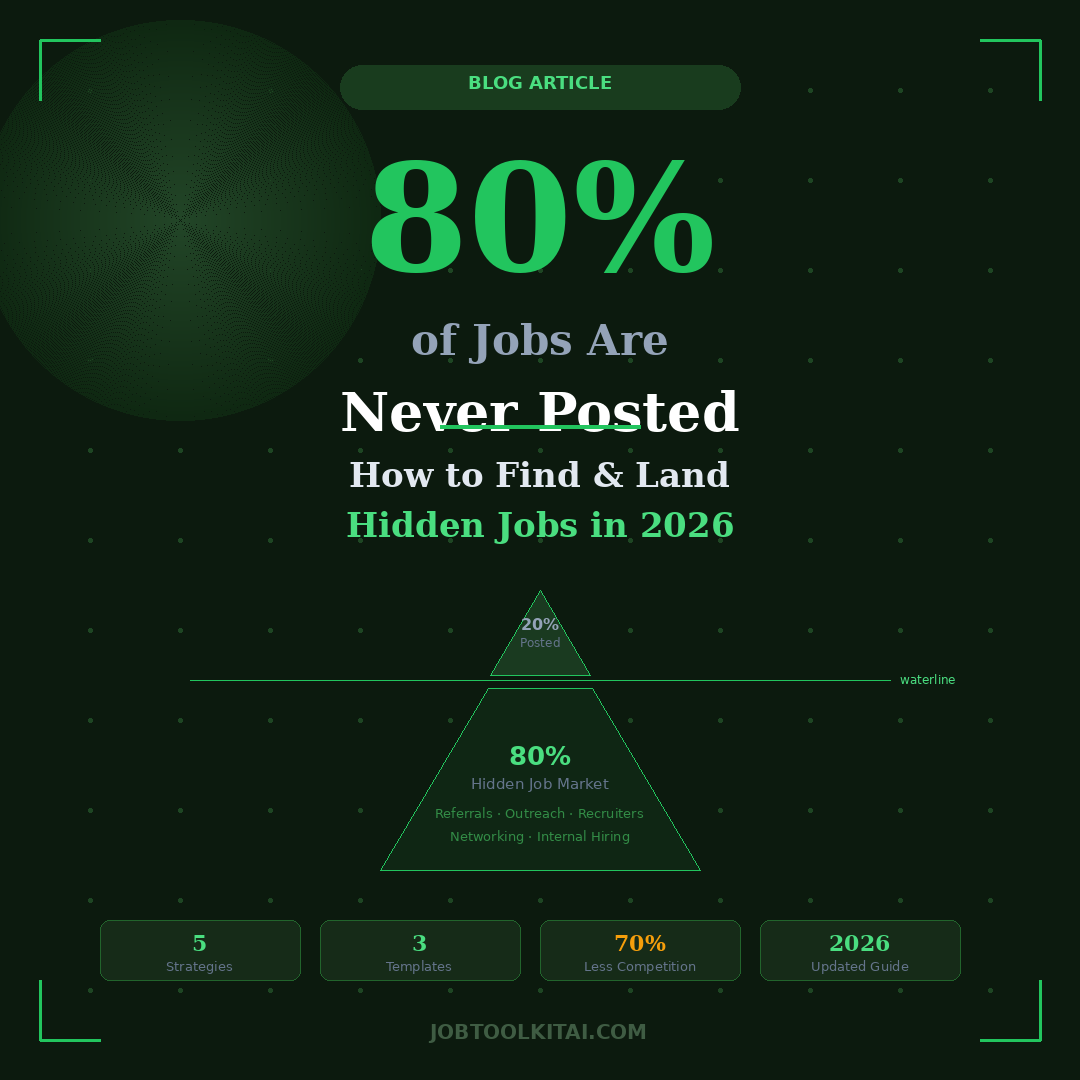
Research consistently shows that 70–80% of job openings are never publicly advertised. They’re filled through internal referrals, direct outreach, recruiter networks, and conversations that happen long before a job listing goes live. This is what career experts call the **hidden job market** — and in 2026, it’s bigger than ever.
If you’re only applying to jobs you find on LinkedIn, Indeed, and Glassdoor, you’re competing for roughly 20% of available opportunities against hundreds (sometimes thousands) of other applicants. The other 80%? They’re being filled by people who know how to look in the right places.
This guide breaks down exactly where hidden jobs exist, why companies prefer to hire this way, and five actionable strategies you can start using today to access them.
## Why Do Companies Hide Jobs?
It sounds counterintuitive — why wouldn’t a company want to cast a wide net? But hiring managers have very practical reasons for keeping roles off public job boards.
**It saves time and money.** A single job posting on LinkedIn or Indeed can attract 250+ applications. Screening that volume takes weeks and costs thousands in recruiter hours and ATS software fees. When a hiring manager already knows someone qualified — through a referral, a recruiter, or a direct message — they skip all of that.
**Confidentiality matters.** Sometimes companies are replacing an underperforming employee who hasn’t been told yet. Other times, they’re making a strategic hire that signals a new direction they don’t want competitors to know about. Posting these roles publicly would create problems.
**Referral hires perform better.** Data shows that referred candidates are hired significantly faster and stay in roles longer than candidates who apply through job boards. Hiring managers know this, so they ask their team first: “Do you know anyone good for this?”
**AI has flooded job boards.** In 2026, AI-powered auto-apply tools have made it trivially easy to submit hundreds of applications per day. The result is that public job postings are drowning in volume, much of it low-quality. Employers are increasingly turning to private channels just to find signal in the noise.
Understanding these reasons isn’t academic — it tells you exactly how to position yourself. You don’t need to be lucky. You need to be visible in the right places before the job is posted.
## Strategy 1: Turn Your LinkedIn Into a Recruiter Magnet
Before you send a single outreach message, your LinkedIn profile needs to work for you passively. Recruiters search LinkedIn the same way you search Google — they type keywords and filter results. If your profile doesn’t contain the right terms, you’re invisible even when jobs exist.
**Optimize your headline beyond your job title.** Instead of “Marketing Manager at XYZ Corp,” write something like “Marketing Manager | B2B SaaS Growth | Demand Gen & Content Strategy | Driving Pipeline from $2M to $8M.” This headline is packed with keywords recruiters actually search for, and it immediately communicates value.
**Rewrite your About section for your next role, not your current one.** Lead with what you want to be known for. Include 5-7 keywords from your target role’s typical job description. End with a clear statement that you’re open to opportunities.
**Turn on “Open to Work” selectively.** LinkedIn lets you signal to recruiters (without telling your current employer) that you’re open. Set your preferred role titles, locations, and work types. This alone can increase recruiter outreach significantly.
**Post and engage regularly.** Even one thoughtful post per week about your industry puts you on hiring managers’ radar. Comment meaningfully on posts from people at your target companies. The LinkedIn algorithm rewards engagement — and so do recruiters who notice you showing up consistently in their feed.
## Strategy 2: The Warm Outreach Method
This is the single most effective strategy for accessing hidden jobs — and the one most people skip because it feels uncomfortable. Warm outreach means reaching out to people in your existing network (or one degree away) with a specific, non-pushy message.
**Start with your existing connections.** Make a list of everyone you know who works at a company you’d want to join — former colleagues, college classmates, friends of friends, people you’ve interacted with on LinkedIn. You probably know more people than you think.
**Use this outreach template:**
> Hi [Name],
>
> Hope you’re doing well! I’ve been following [Company]’s work on [something specific — a product launch, a blog post, a recent hire], and I’m really impressed with the direction the team is heading.
>
> I’m currently exploring new opportunities in [your target area] and wanted to ask — does your team have any upcoming needs in [specific function]? I’d love to learn more about what it’s like working there, even if there’s nothing open right now.
>
> No pressure at all — and if you know anyone else I should connect with, I’d welcome the introduction.
>
> Thanks, [Your name]
**Why this works:** You’re not asking for a job. You’re asking for information and expressing genuine interest. This lowers the barrier for the other person to respond, and it often triggers them to think: “Actually, we might have something coming up.” Even if they don’t, they’ll remember you when something does open up.
**Follow up once after 5-7 days** if you don’t hear back. Keep it short:
> Hi [Name], just wanted to bump this in case it got buried. No rush at all — I’d love to connect whenever works for you.
Most people don’t follow up, which means most outreach dies after one message. A simple, polite follow-up doubles your response rate.
## Strategy 3: Target Companies, Not Job Postings
Instead of scrolling job boards and reacting to whatever’s posted, flip the script: identify 15-20 companies you’d love to work for and pursue them directly.
**Build your target company list.** Choose companies based on industry, size, culture, location, and growth trajectory — not just whether they have an open role right now. Use LinkedIn, Glassdoor, and Crunchbase to research.
**Find the right person to contact.** For each company, identify the hiring manager for your function (not HR, not a recruiter — the person who would be your actual boss). On LinkedIn, search for titles like “VP of Marketing” or “Engineering Manager” at your target company.
**Send a speculative message:**
> Hi [Name],
>
> I’m a [your title] with [X years] of experience in [your specialty]. I’ve been following [Company]’s growth in [specific area] and I’m genuinely excited about what you’re building.
>
> I’m not seeing an open role that fits right now, but I wanted to introduce myself in case something comes up. I’ve [one sentence about a relevant achievement that would matter to them].
>
> Would you be open to a brief 15-minute call? I’d love to learn more about the team’s direction and see if there might be a fit down the line.
>
> Either way, I appreciate your time.
>
> [Your name]
> [LinkedIn profile URL]
**Here’s what happens next:** In many cases, hiring managers are already thinking about their next hire — they just haven’t gotten around to writing the job description yet. Your message arrives at exactly the right time. Even when the timing isn’t perfect, you’ve planted a seed. When the role does open, your name is already on their radar, and you’ve bypassed the entire ATS gatekeeping process.
## Strategy 4: Leverage Recruiter Relationships
External recruiters and staffing agencies operate almost entirely within the hidden job market. They’re paid by companies to find candidates for roles that are often never posted publicly.
**Connect with recruiters who specialize in your industry.** Search LinkedIn for recruiters at firms that focus on your field — Robert Half for finance, Insight Global for tech, Creative Circle for marketing and design, etc. Send a connection request with a personalized note mentioning your target role.
**Make their job easy.** Recruiters are juggling dozens of open positions. The candidates who get placed fastest are the ones who clearly communicate three things: what role they want, what salary range they’re targeting, and when they can start. Don’t be vague. Specificity helps recruiters match you to the right opportunity quickly.
**Stay in touch quarterly.** Even if nothing comes up immediately, a brief check-in every 2-3 months keeps you top of mind. Recruiters fill roles fast when they open — having a shortlist of pre-vetted candidates is gold for them.
## Strategy 5: Join Communities Where Hiring Happens Informally
Some of the best job leads in 2026 come from Slack channels, Discord servers, niche subreddits, and private industry communities — places where hiring managers casually post “we’re looking for someone” before creating a formal listing.
**Where to look:**
– **Slack communities:** Many industries have active Slack groups (e.g., Lenny’s Newsletter community for product managers, Superpath for content marketers, Rands Leadership for engineering leaders). Jobs posted here often skip the public listing stage entirely.
– **Twitter/X and LinkedIn comments:** Hiring managers frequently tweet or post that they’re hiring. Engaging with these posts — not just liking, but adding a thoughtful comment or DMing — can lead directly to conversations.
– **Industry-specific forums:** GitHub Discussions for developers, Dribbble for designers, Behance for creatives. Active participation in these communities signals expertise and puts you in front of decision-makers.
– **Alumni networks:** Your college, bootcamp, or certification program likely has an alumni network where job leads are shared before they go public.
**The key principle:** These communities reward contribution, not self-promotion. Don’t join and immediately post “I’m looking for a job.” Instead, share insights, answer questions, and help others. When you’ve established yourself as a genuine member, mentioning your job search becomes natural and welcome.
## The Compound Effect: Combining All 5 Strategies
Any one of these strategies can land you a job. But the real power comes from running them simultaneously:
– Your LinkedIn profile attracts inbound recruiter messages while you sleep.
– Your warm outreach surfaces opportunities from people who already know and trust you.
– Your targeted company approach puts you in front of hiring managers before they post anything.
– Your recruiter relationships give you access to a pipeline of roles you’d never find on your own.
– Your community involvement builds your reputation and generates organic leads.
When you combine these channels, you’re no longer one of 300 applicants competing for a single posted role. You’re one of maybe 3-5 people a hiring manager is considering for a role that hasn’t even been listed yet. The competition drops dramatically, and your leverage goes up.
## How to Systematize Your Hidden Job Search
Running five strategies simultaneously sounds overwhelming — until you build a system around it.
**Week 1:** Optimize your LinkedIn profile and turn on “Open to Work.” Build your target company list (15-20 companies). Identify 2-3 recruiters in your industry.
**Week 2:** Send 10 warm outreach messages to existing connections. Send 5 speculative messages to hiring managers at target companies. Join 2-3 relevant communities.
**Week 3 onward:** Send 5-10 new outreach messages per week. Follow up on all previous messages. Post on LinkedIn once per week. Engage in communities 15 minutes per day.
**Track everything** in a simple spreadsheet: company name, contact name, date reached out, response status, follow-up date. The job seekers who land roles fastest treat their search like a sales pipeline — because that’s exactly what it is.
## Stop Competing. Start Connecting.
The hidden job market isn’t a secret club with a locked door. It’s simply the natural way most hiring happens — through relationships, reputation, and direct conversations. The tools and strategies to access it are available to everyone. Most people just don’t use them because applying online feels easier.
But “easier” isn’t working. If your inbox is full of rejection emails (or worse, silence), it’s time to change the game entirely.
The **[JobToolKitAI] includes a complete Hidden Job Finder Strategy — a step-by-step system for identifying, approaching, and landing unadvertised roles, along with 30+ outreach and networking message templates you can customize in minutes.
**[Get the full toolkit for $39 → One-time payment. No subscription. Includes 125+ AI prompts, 100+ ATS resume templates, interview prep, salary negotiation scripts, and the hidden job strategy.
—
## Frequently Asked Questions
### Is the hidden job market real, or is it just a myth?
It’s very real. Multiple studies and workforce analyses confirm that 70–80% of positions are filled through internal channels, referrals, and direct recruitment rather than public job postings. This has been consistently documented across industries and only accelerated in 2026 as AI-driven application tools flooded public job boards with volume.
### How do I network if I’m an introvert or don’t have many connections?
You don’t need thousands of connections. Start with 10-15 people you genuinely know — former colleagues, classmates, friends in your industry. Send a simple, specific message (not “Do you have a job for me?” but “I’m exploring opportunities in [area] — would love your perspective”). You can also build connections passively by posting useful content on LinkedIn and engaging in online communities.
### How long does it take to find a job through the hidden market?
It varies, but most people who actively work the strategies above start seeing conversations and leads within 2-3 weeks. The timeline to an actual offer depends on your industry, seniority level, and how consistently you execute. The key advantage is that when a role materializes through your network, the hiring process is typically much faster than the traditional apply-interview-wait cycle.
### Should I stop applying to posted jobs entirely?
No. Think of it as portfolio allocation — spend roughly 30% of your time on job board applications and 70% on hidden market strategies. Posted jobs still lead to hires, but the competition is much steeper. By diversifying your approach, you dramatically increase your overall odds.
### What if I reach out to a hiring manager and they don’t respond?
Follow up once after 5-7 days. If there’s still no response, move on without taking it personally. Hiring managers are busy, and a non-response rarely means they’re not interested — it usually means your message got buried. Keep sending outreach to other contacts. It’s a numbers game, and consistency always wins.